Governance, Social Media and Government Policy in Nigeria
DOI:
https://doi.org/10.69581/RJPA.2026.13.02Keywords:
Social media, Governance, Government policy, Government regulation, Policy instruments, Civic engagementAbstract
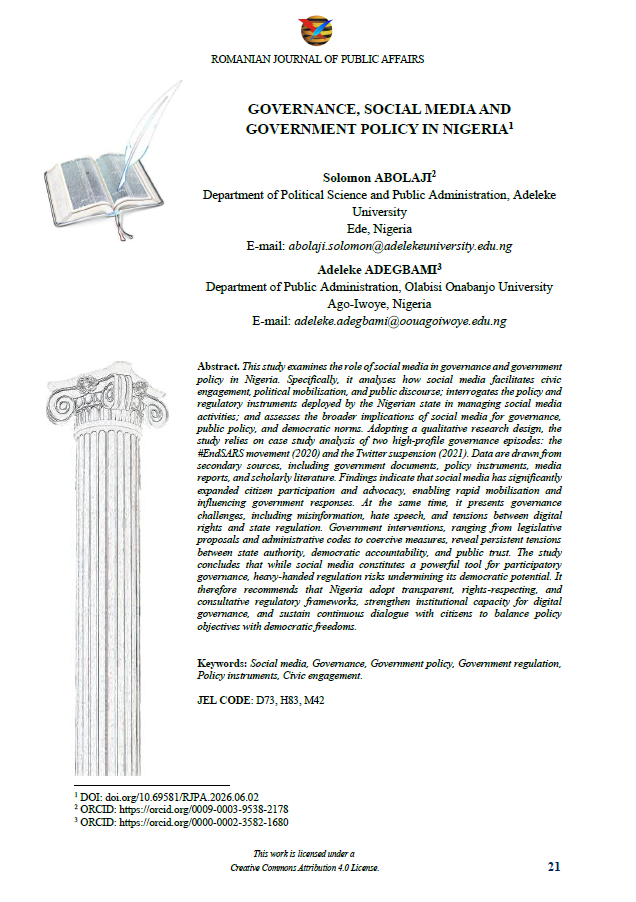
This study examines the role of social media in governance and government policy in Nigeria. Specifically, it analyses how social media facilitates civic engagement, political mobilisation, and public discourse; interrogates the policy and regulatory instruments deployed by the Nigerian state in managing social media activities; and assesses the broader implications of social media for governance, public policy, and democratic norms. Adopting a qualitative research design, the study relies on case study analysis of two high-profile governance episodes: the #EndSARS movement (2020) and the Twitter suspension (2021). Data are drawn from secondary sources, including government documents, policy instruments, media reports, and scholarly literature. Findings indicate that social media has significantly expanded citizen participation and advocacy, enabling rapid mobilisation and influencing government responses. At the same time, it presents governance challenges, including misinformation, hate speech, and tensions between digital rights and state regulation. Government interventions, ranging from legislative proposals and administrative codes to coercive measures, reveal persistent tensions between state authority, democratic accountability, and public trust. The study concludes that while social media constitutes a powerful tool for participatory governance, heavy-handed regulation risks undermining its democratic potential. It therefore recommends that Nigeria adopt transparent, rights-respecting, and consultative regulatory frameworks, strengthen institutional capacity for digital governance, and sustain continuous dialogue with citizens to balance policy objectives with democratic freedoms.